Gold Sovereign Guide UK: History, Buying, Value and Tax

The gold sovereign is one of the most recognisable gold coins in the UK. It combines standardised bullion specifications, royal history, legal-tender status and collector demand.
This page is structured as a central hub for the gold sovereign. It covers what a sovereign is, why it matters, UK tax treatment, authenticity, pricing, storage and resale, while linking to the dedicated articles on sovereign weights, mint marks and Britannias.
The main product route is the gold coins collection.
What is a gold sovereign and why does it matter?
A modern gold sovereign is a British £1 coin made from 22-carat gold. Its standard fineness is 916.7, meaning that 916.7 parts per 1,000 are fine gold.
The traditional full sovereign has:
- Gross weight: 7.98g
- Fine gold content: approximately 7.32g
- Purity: 22ct, or 916.7 fineness
- Diameter: 22.05mm
- Nominal value: £1
The £1 face value is not the coin’s market value. A sovereign trades according to its gold content, condition, date, mint, design, provenance and collector demand.
The sovereign matters because it combines:
- Standardised UK gold-coin specifications
- Long historical continuity
- Strong recognition in the UK market
- Legal-tender status
- Active bullion and collector demand
Gold sovereign weights and sizes: full breakdown
The detailed weights and fine-gold table belongs in the dedicated guide: Gold Sovereign Weights and Fine Gold Content Explained.
At hub level, the key reference point is the full sovereign at 7.98g gross weight and approximately 7.32g fine gold. Double, half and quarter sovereigns follow the same 22ct standard, with different total and fine-gold weights.
Gold sovereign history
The original sovereign was introduced by Henry VII in 1489. The denomination was later discontinued before being reintroduced in 1817 following the Coinage Act 1816 and the Great Recoinage.
The modern sovereign was issued under George III as a £1 gold coin containing 22ct gold. The 1817 design established the specifications and format that remain associated with the sovereign today.
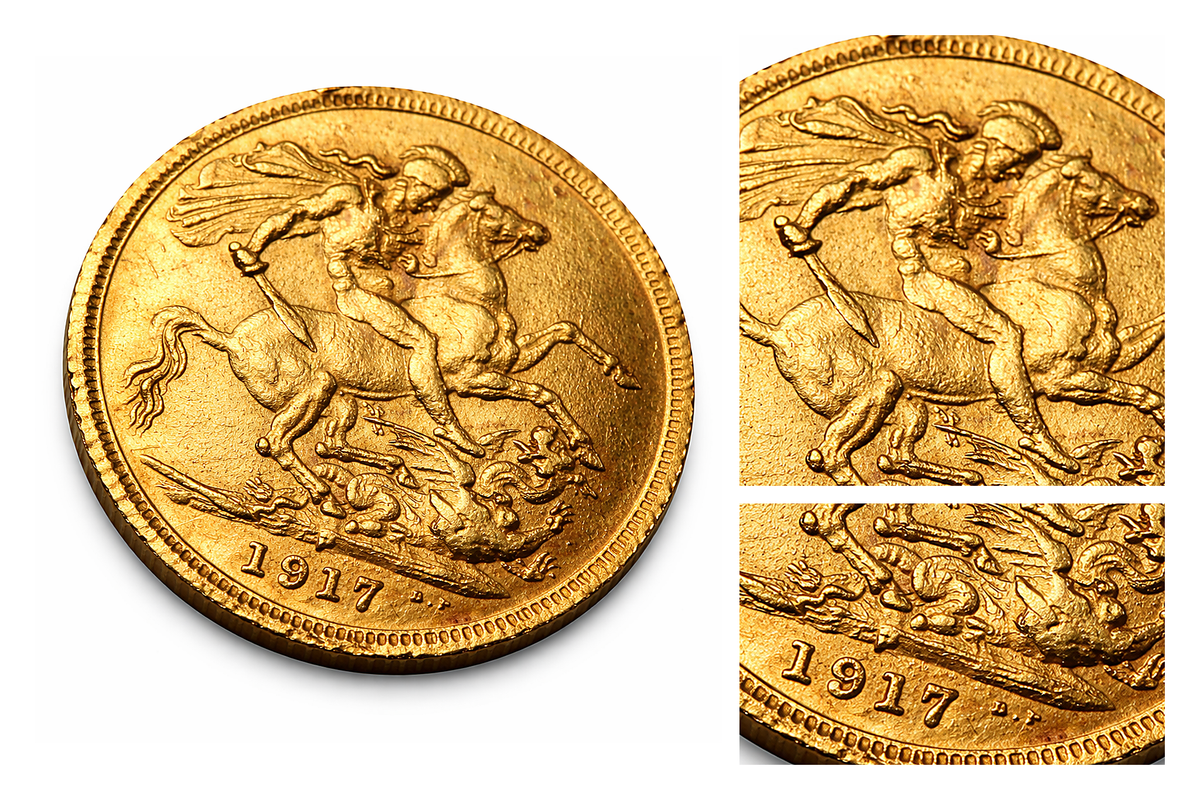
The reverse featured St George and the Dragon, designed by Italian engraver Benedetto Pistrucci. The design shows St George mounted on horseback, confronting the dragon. It became one of the defining images in British coinage.
Sovereigns were subsequently issued under:
- George III
- George IV
- William IV
- Queen Victoria
- Edward VII
- George V
- Edward VIII
- George VI
- Elizabeth II
- Charles III
The reverse design was not identical across every period. During the Victorian era, shield-reverse sovereigns were produced alongside St George and the Dragon issues. The shield displays the Royal Arms and is particularly relevant to collectors of Victorian coins.
From 1871 to 1887, both shield and St George reverses were used. After 1887, St George and the Dragon became the primary sovereign reverse for more than a century.
Modern sovereigns continue the historical format while introducing new monarch portraits, commemorative issues and occasional design variations.
Gold sovereign mint marks: full guide
A mint mark identifies where a sovereign was struck. London sovereigns generally have no mint mark. Overseas branch mints used letters to identify their production.
The full mint-mark breakdown belongs in the dedicated guide: Gold Sovereign Mint Marks: Identify Where It Was Struck.
At hub level, the main point is that the mint mark identifies the striking mint, not the source of the gold. On St George and the Dragon sovereigns, the mark is normally found on the ground line above the date. London sovereigns usually have no mint mark.
A useful example is the 1917 King George V Full Gold Sovereign – Perth Mint. The product description identifies the P mint mark above the date, together with a 7.98g gross weight, 7.3224g fine gold content and 916.7 fineness.
Legal tender and CGT exemption
Gold sovereigns have a nominal UK legal-tender value of £1 for a full sovereign, regardless of their substantially higher gold and collector value.
HMRC guidance treats sterling sovereigns minted from 1837 onwards as UK currency. Qualifying sterling legal-tender sovereigns are generally outside Capital Gains Tax under the currency exemption in TCGA 1992. This means that gains on qualifying coins are generally not subject to CGT for UK private owners.
This treatment should not be applied automatically to every coin described as a sovereign. Pre-1837 pieces, non-sterling issues, medallions and coins that are not UK legal tender may have different treatment. Income Tax, Inheritance Tax and trading activity are separate considerations.
The UK Budget scheduled for 28 October 2026 may affect wider taxation policy. Any future announcement should be checked against current HMRC guidance before relying on existing tax treatment. Tax advice should be obtained for substantial holdings, estates or unusual coins.
Premium over spot and how to compare pricing
A sovereign’s base bullion value is calculated from its fine gold content:
Fine gold content × current gold price per gram = approximate metal value
For a full sovereign, the calculation uses approximately 7.32g of fine gold, not the 7.98g gross weight.
The selling price normally includes a premium over the underlying gold value. The premium can reflect:
- Dealer operating costs
- Market supply and demand
- Coin condition
- Date and monarch
- Mint mark
- Rarity
- Historical importance
- Presentation and documentation
- Buy-back liquidity
Common modern sovereigns in circulated condition may trade relatively close to bullion value. Scarce dates, rare varieties, high-grade examples and historically important coins can carry a larger numismatic premium.
A 1917 Perth sovereign and a 1917 London sovereign should not be valued identically. The Perth issue is a branch-mint coin identified by the P mark. The London issue is a substantially rarer coin. Mint, date and condition must be confirmed before comparing prices.
When comparing listings, calculate the implied price per gram of fine gold, then assess whether the additional premium is justified by the coin’s collectability.
Authenticity and how to buy safely in the UK
Authentication should involve more than checking the colour of the metal.
Basic checks include:
- Weight: Compare the coin with the correct specification for its size.
- Diameter: A full sovereign should measure approximately 22.05mm.
- Design: Inspect the monarch portrait, lettering, date and reverse details.
- Edge: Check the milling and edge profile for inconsistencies.
- Mint mark: Confirm that the mark matches the stated date and mint.
- Surface: Look for casting defects, blurred detail, unusual porosity or tool marks.
- Magnet test: Gold is not magnetic, but this test alone cannot authenticate a coin.
- Professional assessment: Use an experienced dealer or independent specialist for valuable, rare or disputed examples.
A sovereign should not be cleaned, polished or aggressively rubbed. Cleaning can damage the original surface and reduce collector value.
Condition and grading basics
Condition describes the amount of wear and surface alteration on a coin. Common grading terms include:
- Poor: Major wear. Details are heavily obscured.
- Fine: Moderate circulation wear. Main design elements remain identifiable.
- Very Fine: Clear detail with visible wear on raised areas.
- Extremely Fine: Light wear and substantial original detail.
- About Uncirculated: Minimal evidence of circulation.
- Uncirculated: No meaningful circulation wear, although marks from handling or production may remain.
- Proof: Specially manufactured coin with polished fields and detailed frosted design elements.
Third-party grading services may assign numerical grades, but grading should be considered alongside authenticity, provenance and the specific variety. A high grade can increase value, but a rare date may remain valuable even in circulated condition.
A reputable UK seller should provide:
- Accurate gross weight and fine gold content
- Stated purity or fineness
- Clear photographs of the actual coin
- Date, monarch and mint information
- Condition description
- Transparent pricing
- Secure, insured delivery
- A clear returns policy
- Contact details and responsive customer service
The primary internal route is the gold coins collection, which includes sovereigns and other historic gold coins.
Product-specific information is available for the 1917 King George V Full Gold Sovereign – Perth Mint. The product page lists the coin’s 7.98g weight, 7.3224g pure gold content, 916.7 fineness and 22.05mm diameter.
Storage and resale
Gold sovereigns should be stored in a protective capsule, suitable coin holder or inert storage material. Avoid PVC-based holders, which can damage the surface over time.
Recommended controls include:
- Handle coins by the edge.
- Avoid touching the fields and raised design.
- Keep coins dry and away from chemicals.
- Store documentation with the coin.
- Record purchase date, price, description and photographs.
- Use secure home storage or a specialist safe-deposit facility.
- Obtain appropriate insurance for valuable collections.
For resale, retain the original description, invoices, grading certificates and provenance records. A dealer will typically assess the coin’s authenticity, weight, condition, date, mint mark and market demand before making an offer.
Gold sovereigns versus Britannias
The detailed comparison belongs in the dedicated article: Gold Sovereigns vs Britannias: Which Suits You?.
At hub level, the distinction is simple. A sovereign is a smaller 22ct UK gold coin with strong historical and collector relevance. A Britannia is typically used as a larger-format modern bullion reference point.
Frequently asked questions
What is a full gold sovereign worth?
Its value depends on the current gold price, approximately 7.32g of fine gold, dealer premium, date, mint, condition and collector demand. The £1 face value does not represent its market value.
How much gold is in a sovereign?
A full sovereign weighs approximately 7.98g and contains approximately 7.32g of fine gold. It is made from 22ct gold with 916.7 fineness. The full breakdown by sovereign size is in Gold Sovereign Weights and Fine Gold Content Explained.
Are gold sovereigns 24ct?
No. Standard sovereigns are 22ct gold, or 916.7 fineness. The remaining alloy improves durability.
Is a gold sovereign legal tender in the UK?
Yes. A full sovereign has a nominal legal-tender value of £1. Its market value is based on gold content and collector factors.
Are gold sovereigns exempt from CGT?
Qualifying UK sterling sovereigns minted from 1837 onwards are generally treated as sterling currency and are outside CGT. Non-qualifying coins and unusual cases may be treated differently.
What does P mean on a sovereign?
P identifies the Perth Mint in Australia. On St George and the Dragon sovereigns, it is normally located above the date. The full branch-mint guide is in Gold Sovereign Mint Marks: Identify Where It Was Struck.
Is a rare gold sovereign worth more than its gold content?
Usually, if the date, mint, variety, condition or provenance attracts collector demand. The premium varies and should be compared with recent market evidence.
Where can gold sovereigns be bought safely in the UK?
Purchase from an established dealer that provides accurate specifications, clear photographs, secure delivery, a returns policy and direct customer support. Gold2u’s gold coins collection provides access to available historical gold coins and modern issues.